Professional Walkie-Talkies Classification

In the field of wireless communication, professional walkie-talkies serve as essential tools for instant communication, widely utilized across various industries, including public safety, emergency rescue, transportation, construction, and outdoor adventures. Their efficient and reliable communication capabilities are crucial for ensuring team collaboration and effective on-site command.
As technology has progressed, the types of walkie-talkies have become increasingly diverse, primarily categorized as follows:
1. Analog Walkie-Talkies
Analog walkie-talkies transmit signals using analog technology. They are known for being cost-effective and for their mature technology. However, as communication technologies evolve, analog walkie-talkies have begun to show limitations in terms of interference resistance, spectrum efficiency, and data transmission speed. Nevertheless, they still hold a market presence in specific environments or cost-sensitive applications where communication quality demands are lower.
2. Digital Walkie-Talkies
Digital walkie-talkies utilize digital technology for processing audio and data signals, offering higher interference resistance, better voice quality, and a wider range of features. It supports technologies such as digital encryption, voice compression, and efficient spectrum utilization, catering to more complex and demanding communication needs. With the continuous advancement and adoption of digital technology, digital walkie-talkies have become the mainstream choice in professional communications, especially in scenarios requiring high security and efficient communication.
Digital walkie-talkies utilize digital technology for processing audio and data signals, offering higher interference resistance, better voice quality, and a wider range of features. It supports technologies such as digital encryption, voice compression, and efficient spectrum utilization, catering to more complex and demanding communication needs. With the continuous advancement and adoption of digital technology, digital walkie-talkies have become the mainstream choice in professional communications, especially in scenarios requiring high security and efficient communication.
Common Digital Walkie-Talkie Standards Include:
P25 (Public Safety Radio Standard): Developed by the National Public Safety Telecommunications Council (NPSTC) and the Telecommunications Industry Association (TIA), P25 enhances the reliability and interoperability of emergency communications, supporting various communication modes and services, including voice, data, and video transmission. P25 walkie-talkies are widely employed by police, fire, and emergency medical services, renowned for their robust security and stability.
P25 (Public Safety Radio Standard): Developed by the National Public Safety Telecommunications Council (NPSTC) and the Telecommunications Industry Association (TIA), P25 enhances the reliability and interoperability of emergency communications, supporting various communication modes and services, including voice, data, and video transmission. P25 walkie-talkies are widely employed by police, fire, and emergency medical services, renowned for their robust security and stability.
DMR (Digital Mobile Radio) Walkie-Talkies: Based on the open digital standard established by the European Telecommunications Standards Institute (ETSI), DMR walkie-talkies are favored for their low cost, simplicity, and cross-brand interoperability. The DMR standard supports voice communication, short messaging services, and data transmission, making them suitable across public safety, utilities, commercial, and industrial communications. DMR walkie-talkies typically deliver clear voice quality, efficient spectrum use, and flexible communication modes, making them one of the most common types of digital walkie-talkies in the market.
dPMR (Digital Private Mobile Radio) Walkie-Talkies: This digital protocol is designed for professional mobile communication, combining efficient spectrum utilization with high-quality voice clarity,
supporting both voice and data communications. dPMR is widely applied in public safety, transportation, and outdoor exploration, especially in environments that demand quick responses and
effective communication.
TETRA (Terrestrial Trunked Radio) Walkie-Talkies: Another digital trunking standard set by the European Telecommunications Standards Institute, TETRA utilizes Time Division Multiple Access
(TDMA) technology to facilitate digital trunked communication systems. It supports efficient spectrum usage, high data rate transmission, and advanced security features, such as encryption and
authentication. TETRA is extensively used in complex communication environments like airports, ports, and subways, ensuring rapid and accurate communication during emergencies.
The classification of professional walkie-talkies is diverse, with each type offering unique advantages and suitable applications. As technology continues to advance, walkie-talkies are evolving towards greater digitization, intelligence, and connectivity, providing users with a more efficient, secure, and convenient communication experience.
As a professional walkie-talkie accessory manufacturer, Power Time is committed to keeping pace with industry trends(for example the newly launch of full-duplex wireless intercom headset AG-6), providing high-quality, high-performance communication solutions for global users, facilitating effective communication and collaboration across various sectors.
Earhook Earphones for Two-Way Radios: The Convenient Choice for Communication
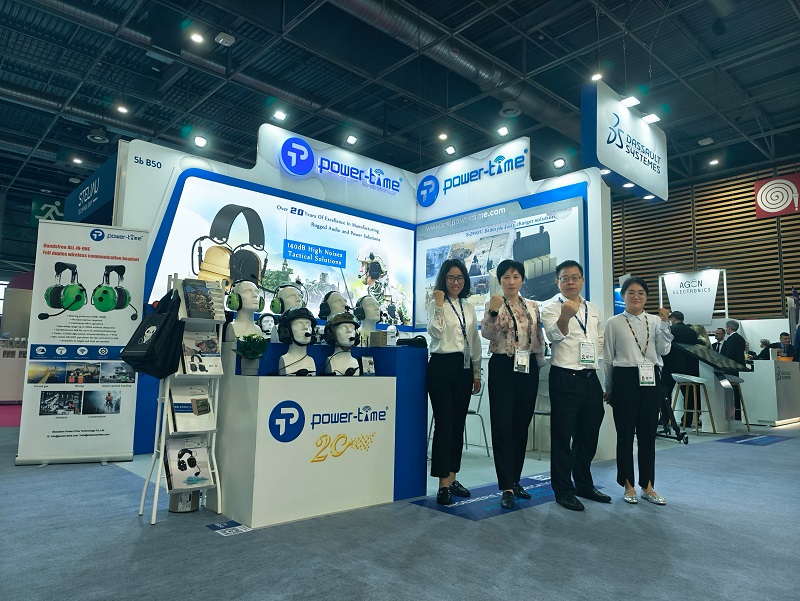
Congratulations on the Successful Conclusion of Power-Time's EUROSATORY Exhibition!
Related blog